Author:
 is a comic book writer from Scotland, living in Japan. He researches issues of sustainability in Japan, campaigning for the re-greening of Japanese cities. He has had more than 40 books published with a variety of US, UK and Japanese publishers, including: a comic book version of A Christmas Carol (‘Best of 2008’, Sunday Times), AX:alternative manga (‘Best ten books of 2010’, Publishers Weekly), Parecomic (with an introduction by Noam Chomsky) and his book ’The Many Not the Few’ was launched at a special event in the House of Commons parliament building. In 2016 his book The Faceless Ghost was nominated for the prestigious Eisner Book Awards, and received a medal in the 2016 Independent Publisher Book Awards. In 2017 his book Secrets of the Ninja won an International Manga Award from the Japanese government – he is the first British person to receive this award. In 2020 he received the Scottish Samurai Award from an association celebrating links between Japan and Scotland. In 2021 his book ‘The Minamata Story’ won a silver medal in the Freeman Book Awards of Columbia University.
There is a common image that Japanese people love nature. In some ways that is clearly true, thankfully. However, in various important respects what happens in practice seems to go very much against that. In a world increasingly focused on sustainability and protection of the environment there is one habit in Japan which is almost totally unknown in the rest of the world, but a major problem.
I’m referring to the habit of cutting down all or 90% of the trees, bushes and plants in an garden when knocking down the old house there. And replanting either no greenery at all, or only a tiny amount, after erecting a new house there.
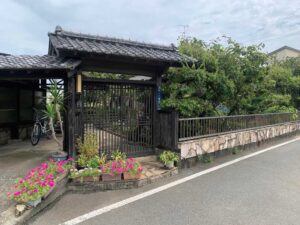
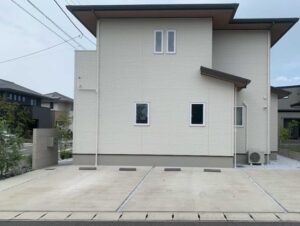
Over the last 10 years I have investigated this on many sites in Japan and taken various before and after photos and have found that it is normal practice by most house building companies, such as Daiwa House and Sekisui House. On average in the sites I studied there were previously around 20 trees or bushes. The majority of the new sites constructed have only 1 tree or a couple of bushes. In about two thirds of the plots there was no greenery kept or replanted at all. This practice means at least a 95% loss to the urban green environment of Japan. The Ministry of Land, Infrastructure, Transport and Tourism (MLIT) reported that there were around 750,000 new houses built across Japan in 2025. Even if we presume that less than half of these – 300,000 – involved destroying 19 trees in the old garden that still means more than 5 million trees and bushes lost to Japan – every year. And that is a conservative estimate, it is probbaly more.
Some would say that of course the land needs to be cleared, in order for the diggers to get access and to allow the foundations of the new house to be laid, etc. Yes, but it is not normally necessary to clear all of a garden for either reason. Access on one or two sides is sufficient, so why not leave the other two or three sides of the garden as is? Why don’t the architects leave an element of the existing garden in their design? It is sometimes done, so it’s not out of the question. Even if near total clearing is necessary for access or new building design then what is the excuse for not making a new garden there later?
So, why has the amount and size of gardens declined so much? As part of my investigations I have pondered: was it common practice in say, 1950 or 1900, to clear the old plot of all previous greenery when building a new house there? Or is this recent? The Shinto land purification ritual (Jichinsai 地鎮祭) is of long standing. But perhaps in the past the whole area was not totally cleared down to just soil? Also: even if land was totally cleared of greenery in the past it seems it was normal to build up a new garden, as even houses built as recently the 1970s often have quite sizeable gardens, with quite a lot of greenery in them. But it’s very rare for new houses over the neast 20 years to have even medium sized gardens. So, what changed? It’s an issue we see around us every day and yet no one seems to know quite why.
In my research economic aspects were mentioned to me several times by various people, both Japanese and long term foreign residents. Many Japanese people, I was told, can’t afford to have a garden, both in terms of the cost of buying land and the cost of paying a gardener to maintain large trees, etc. An underlying issue being the old habit of dividing up the estate among surviving family members, with the land being spit up into three or four smaller lots and the greenery destroyed in the process. Anne Kohtz, an architect in Tsukuba, adds: ‘… a lot of it was originally due to inheritance taxes, which became particularly high after the war. In order to afford the inheritance taxes, people very often had to sell half the land…’ However, this does not seem to be the main factor now, as 90% of the new housing units I have investigated have been on the same size land as the previous old house (or larger, with two neighboring houses made into one larger mansion plot).
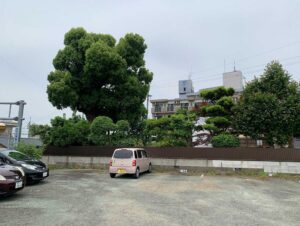
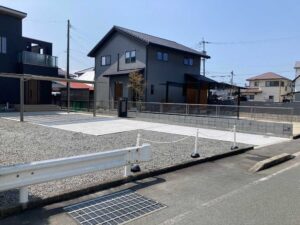
The high land prices during the bubble years of the economy may be a key period in which garden size decreased. During this time it became common for real estate agents to raze the round of any greenery and remove large ornamental stones or ponds to make the plot more appealing to higher-profit commercial clients. It seems perhaps the habit stuck, so that now its normal for land to be cleared, for convenience. Though it’s worth noting that the almost legendary bubble years were quite short (1986 to 1991), meaning we have had almost 30 years of a slow-moving economy, so why would the construction and housing industry still be stuck in an outmoded and environmentally unfriendly 1980s thinking which seems to out of place with what is happening in much of the world?
I contacted such companies, such as Daiwa House and Sekishi House. They often have long reports touting their efforts at sustainability and environmental policies, and proudly display awards to prove it. All that sounds very good, and it seems that various positive efforts are being made, such as solar panels on the roofs of new houses. However, the evidence we can see in the streets of Japan indicates that these fine aims are far from being put into practice in relation to gardens. I have photographic evidence from several sites made by such big companies that show no green areas at all, or only a tiny strip, on new houses which previously contained extensive gardens. I have contacted various of these companies to ask if they will adopt more environmentally policies, and am eagerly awaiting their responses. Daiwa gave me a reply which was evasive, and then declined to reply in more detail. Sekisui were better, replying with various moderately impressive plans and concluding by saying: ‘As a result of these activities, we are planting over 1 million trees per year, and the cumulative number of planted trees since the start of the project in 2001 has reached 16.11 million.’. This offers some hope. The figure of 1 million trees per year here is a positive step, but as I estimate the current loss rate to be around 5 million trees at least, it is necessary for other major building companies to follow suit.
Another financial point that came up: if the problem is a lack of money for gardens then how is it that so many more Japanese seemed to be able to afford them in the past, when Japan was a less well-off country than it is now? Most Japanese people had less money in say, 1930 or even 1960, than they do now, yet houses built then still normally had quite large gardens. A possible explanation for that is that most of those older houses with large gardens were owned by middle class or upper class people, and that the average working class Japanese person in, say, 1930, had no garden then either.
However, that is also partially unsupported by my recent research, in which often a family of a roughly similar income group moves into the new plot, but does not keep the previous garden or replant another. A related point though may be that less grandparents live with their children nowadays. Some I have spoken too said that it was common for granny and grandad to look after those old gardens in the past. If nowadays less grandparents are there to do that, and both parents are working, then it’s perhaps a reason why gardens get neglected. A general point mentioned was that some people think of trees are a source of bugs and slippery leaves, basically just a nuisance.
How about the point that many Japanese simply can not afford land big enough for a garden? A bit more of the old empirical investigation showed this idea to be less strong than it seems: my research has shown that very often the area is still large enough for a garden, or for 2 or 3 green areas. As noted above in about two thirds of the cases I have visited no green areas were made, despite more than 90% having space for it. Even apart from car parking its common to leave quite a lot of space completely empty, concreted over, within the new housing plots. The free space is there, so elements of the existing garden could be kept or new green areas made for not that much more cost, especially to very wealthy housing companies, but simply are not.
Anne also mentioned an element I had not thought of before: air conditioners. Thanks to the wide spread use of these: ‘…a traditional garden is no longer used as a natural air conditioner, which was really necessary 50 or 60 years ago. Since most people have mechanical air conditioners, having a garden space, engawas to open, fu-rin bells to psychologically feel cooler, and the jimado-ranma combination to promote stack cooling are no longer necessary’. This sounds like a possible culprit to me, though some Japanese people I have asked about it did not agree. A related point is that concrete radiates heat back into the air. So that the destruction of so many gardens and the replacement by large areas of concrete is playing a role in why summers are getting hotter in Japan. In addition it is well known that gardens help flood water drain more quickly. So if you don’t like the heat and floods, keep the garden!
Convenience is we might say a modern virus which appears to help us but which often ends up making things worse. For example, the loss of cooking skills thanks to microwaves; music being easily available online meaning people no longer have that great feeling of finding a rare piece of vinyl in some dank record shop; and the loss of the beauty and health benefits of gardens, because they are simply too much bother.
However, much as the beauty of vinyl records has made something of a comeback in recent years and cooking programs refocus us on the enjoyment of baking a cake yourself, we can hope in Japan the general feeling may move back to the idea that gardens are worth it.
All the above does not mean that Japanese people, across the board, are indifferent to nature now. We might say that a continued respect and love for nature is partly what makes this habit so jarring. But also where positive change may come from. Ironically one of the reasons for the habit may be because Japanese people continue to hold nature in high regard, a Japanese lawyer in Nagoya told me: ‘Some people consider it to be disrespectful not to look after trees and plants, but since they don’t have enough time they think it’s better not to have a garden at all.’
My own research supports this point. I was investigating a plot where a lovely big garden was ripped up and replaced with absolutely no trees at all, just bare concrete over a large plot, but was delighted to notice on the next street an example of quite the opposite attitude. There a Japanese man in his 30s was happily making a new garden, by himself, DIY style. He told me that the old house and garden belonged to his grandparents and after building the new house there he had decided to rebuild most of the garden. He expressed disappointment that more people did not do the same. The next week I saw his whole family out laying a new lawn.
So, what I am recommending is that a zoning law be created requiring a minimum of 25% of the previous greenery to be kept or replanted. Not a lot, but much better than the 5% rate happening now. This is the ‘hard’ method, involving the Japanese government at national and municipal levels administering firm and widely applied zoning rules that enforce the replacement minimum, and a penalty imposed for not doing so. If adopted this would soon become part of house building companies procedure and after 5 or 10 years just thought of as normal.
The ‘soft’ method may be to draw on the ‘nudge theory’ of the Nobel prize winning economist, Richard Thaler, which has proven successful in many wide scale changes, such as getting more people to save pension money in the UK. The government could launch a public campaign to rediscover the Japanese love of nature and tie that into have a nice garden. Make it the sign of being a good citizen, with pride in the beauty of Japan. It may influence the choices of house building companies, architects and home owners. Possibly financial incentives could be offered to bolster this: get 10,000 yen for every new tree in your garden! Why not?
Some may say that the 25% regulation is an unwelcome infringement on our rights to decide for ourselves what we do with our property. Yet car parking space is already regulated in much he same way as I’m suggesting. So why not green spaces? Are we saying cars are important but the environment is not? Not only is this bad for the environment, it’s bad for people too. Various studies have confirmed the link between green space and health, such as a study in the Netherlands, that concluded: ‘This research shows that the percentage of green space in people’s living environment has a positive association with the perceived general health of residents. Green space seems to be more than just a luxury and consequently the development of green space should be allocated a more central position in spatial planning policy.’
For these reasons, to decrease the heat, to aid in flood control, as well as preserving the beauty of cities… Japan need to re-green its house gardens.