Source material and expert consultation:
Bohdan Juchniewicz, “Polska Ekologia” Association
Editorial development:
Nature World
Poland has long been one of the key producers of goose meat, feathers and down in the European Union, with a significant share of domestic production destined for export — primarily to Germany, France, Austria and Asian markets. At the same time, goose meat remains a delicacy product in Poland, associated more with November traditions than with everyday cuisine, even though the Polish oat-fed goose is a recognisable mark of quality on foreign markets.
In an era of growing ESG requirements, conscious consumerism and a shift towards organic food, “high product quality” alone is no longer enough. Increasingly important is the story of the entire production system — from the breed of goose and access to pasture, through local feed, to the culturally and economically rooted use of down and feathers.
The Polish Oat-Fed Goose: Between Tradition and Ethology
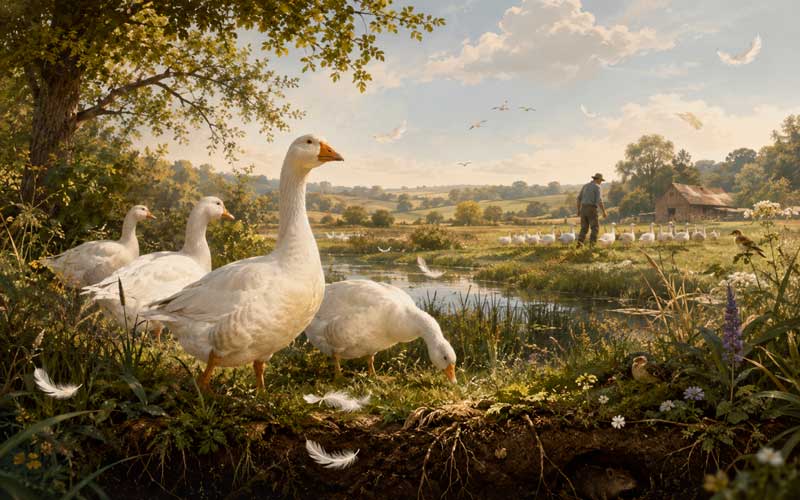
In the Polish model of goose farming, especially in organic variants, access to free-range areas and pastures plays a crucial role, fitting into broader trends aimed at raising animal welfare standards. As a typically pasture-based species, the goose becomes a “living link” in regenerative agriculture: grazing helps maintain meadow biodiversity, reduce weed pressure and improve the circulation of organic matter within the farm ecosystem.
The dominant breed in Poland, the White Kołuda goose, often raised as the “oat-fed goose”, combines traditional husbandry with the requirements of the modern market — from resilience and meat parameters to exceptionally high-quality down. It is precisely the absence of haste, the longer rearing cycle and access to pasture that allow goose meat to achieve a favourable fat profile, while positioning the final product within the premium delicatessen segment.
Supply Chain 5.0: From Local Feed to Luxury Markets
The international success of Polish organic goose meat is largely the result of an integrated value chain that combines breeding, processing, logistics and export within a single quality management model. Leading producer groups — such as Animpol Group — coordinate the entire process: from parent flocks and hatcheries, through contract systems with farms, to certified processing and sales on markets with the highest standards.
Feed innovation is also playing an increasingly important role, alongside a shift away from imported soy towards domestic protein crops such as lupin, faba beans and rapeseed meal. This reduces the environmental footprint and strengthens the local economy. In this way, the organic goose supply chain becomes an example of ESG-aligned practice — from reducing emissions linked to raw-material transport to supporting regional farmers.
Down and Feathers as a Strategic Resource: From Feather-Stripping to the Circular Economy
Goose meat is only one part of the value chain. Equally important are down and feathers, long considered one of the export “specialities” of Polish poultry production. In Polish tradition, however, they were never merely a by-product. Feather-stripping was an important rural custom: it combined work, neighbourly gathering, intergenerational transmission and a real source of additional income for households.
Today, the same idea of resourcefulness can be expressed in the language of the modern circular economy, without reducing it to the slogan of “zero waste”. Natural down from a well-documented source remains one of the most efficient insulation materials for the outdoor and high-quality textile industries, while the fuller use of meat, offal, down and feathers strengthens the argument for treating the Polish goose as a strategic resource for the sustainable industries of the future.
From Product to System
Polish organic goose meat — including the Polish oat-fed goose — already meets the criteria of a luxury product: it is recognised on key foreign markets, has a favourable nutritional profile and is strongly connected to the local landscape. The challenge for the entire sector is to transform its existing raw-material success into a coherent national-brand narrative — one that speaks not only about meat or down, but about an entire system of values: animal welfare, regenerative agriculture, local feed and resourcefulness that connects tradition with circularity.
In this perspective, companies such as Animpol can act as ambassadors of the Polish model — not as the heroes of an advertisement, but as proof that integrated, organic goose production can be economically viable, environmentally responsible and globally competitive at the same time.

Leave A Comment